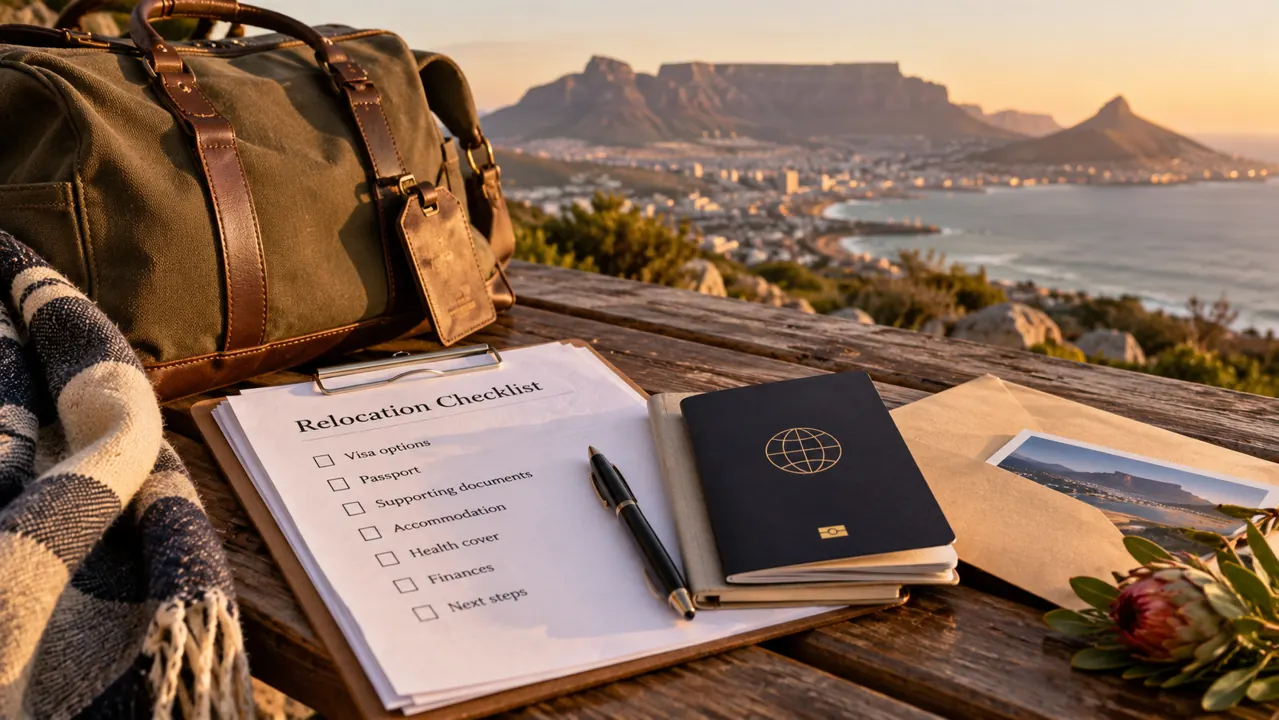
Moving to South Africa from the UK: the complete guide
A practical sequence for choosing a visa, assessing tax and healthcare, selecting a city, planning security and completing a move from the UK.

A long-term move from the UK to South Africa should begin with lawful status and a realistic operating plan. British visitors may usually enter for a limited stay, but visitor status does not create a general right to live or work in the country. For a stay beyond 90 days, or for work, study, retirement, business or family purposes, confirm the appropriate visa with the Department of Home Affairs or the South African mission responsible for your application.
Visa preparation can involve financial evidence, employment or relationship documents, medical and radiology reports, police clearances, qualifications, professional registration and proof of medical cover. The exact evidence depends on the route and current rules. Do not resign, ship possessions or commit to a non-refundable property contract until you understand the application sequence and risk.
Tax residence is separate from immigration. South Africa uses a residence-based system and can treat an individual as resident through the ordinarily resident test or the physical presence test. A resident may be taxable on worldwide income, subject to exemptions and treaty rules. The UK applies its own Statutory Residence Test, and the UK-South Africa treaty may be relevant where both systems initially claim residence.
Healthcare also needs advance planning. South Africa has public and private systems, but there is no reciprocal healthcare agreement with the UK. Many internationally mobile households arrange suitable private medical-scheme membership or insurance and budget separately for gaps, day-to-day benefits, exclusions and emergency transport. Confirm cover before cancelling UK arrangements or relying on travel insurance.
Choose the city and neighbourhood around work, school, healthcare, transport and security rather than scenery alone. Cape Town offers coast and outdoor life but has pressured housing and distinct commuting corridors. Johannesburg is the main commercial centre but highly decentralised. Pretoria suits some government, diplomatic and professional needs. Durban and Umhlanga offer warm coastal living with different infrastructure and weather risks.
Security planning should be calm and specific. Review current official advice, speak to local residents and reputable security professionals, test routes at the times you will use them and understand the property's physical security, power, water and communications resilience. Conditions can vary sharply over short distances, so national or even city averages are not enough.
Families should assess schools before signing a lease. Admissions are provincial for public schools, while independent schools have their own processes, fees and waiting lists. Include daily transport and after-school travel in the decision.
The safest order is: identify the immigration route; obtain coordinated UK-South Africa tax advice; establish healthcare; shortlist cities and schools; assess security and infrastructure; verify housing; prepare documents; and then complete the move and local registrations. Keep written records of applications, travel, tax advice and insurance.
Common questions
- Can a British citizen move to South Africa without a visa?
- A short visitor stay and a long-term move are different. A British citizen generally needs the appropriate visa for a stay beyond the visitor period or for work, study, retirement, business or family residence.
- Is private healthcare essential?
- There is no UK-South Africa reciprocal healthcare agreement. Many relocating households arrange private cover, but the appropriate product and level depend on personal circumstances.
Sources
- Living in South Africa — UK Foreign, Commonwealth & Development Office
- Types of South African visas — South African Department of Home Affairs
- South African tax residence — South African Revenue Service
- Health in South Africa — South African Government
- South Africa safety and security guidance — UK Foreign, Commonwealth & Development Office
This guide provides general information for planning purposes. It does not constitute legal, tax, financial, immigration or medical advice. Always confirm decisions with a qualified specialist authorised to advise for your circumstances.
Related guidance