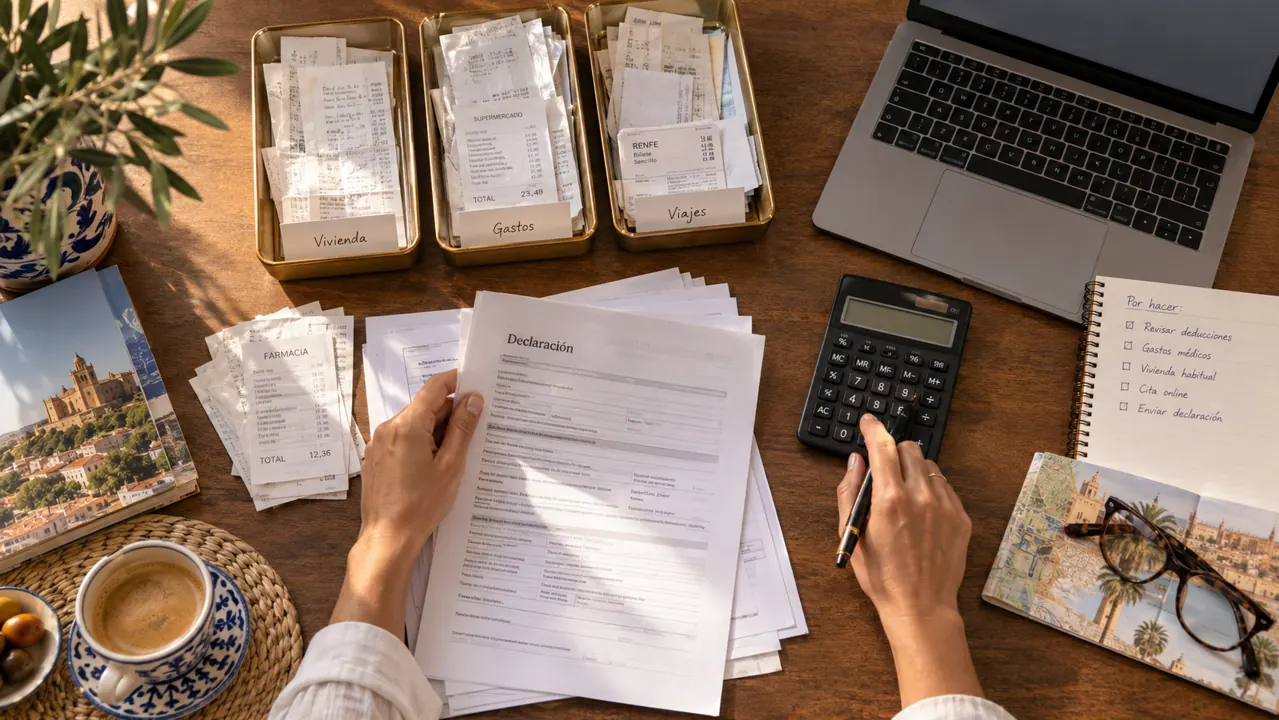
Financial advice for expats living in Spain
The ongoing financial questions to review after settling in Spain—from tax residence and overseas assets to pensions, investments and estate planning.

Spain can be an attractive place to live, but becoming established there changes the context in which your income, investments, pensions and estate plan must be assessed. The important question is rarely whether one product or account is ‘good’. It is whether your arrangements still work when Spanish rules, the rules of another country and any relevant tax treaty are considered together.
This guide is for international residents who already live in Spain or expect to become Spanish tax resident. It explains the areas to organise before seeking personalised advice, the warning signs to look for and the questions a cross-border adviser should be able to answer. It is general information rather than personal tax, legal, pension or investment advice.
Start with tax residence, not nationality
Your nationality does not by itself decide where you are tax resident. Under Spanish domestic rules, an individual may be treated as resident if they spend more than 183 days in Spain during the calendar year, if the main centre of their activities or economic interests is in Spain, or through a rebuttable presumption connected with a spouse and dependent minor children. Sporadic absences can count unless tax residence elsewhere is proved. Spain generally treats a person as resident or non-resident for the whole calendar year.
A residence permit and tax residence are different concepts. Owning a home, registering locally or holding a visa does not settle the tax analysis on its own. Keep a calendar of travel days, evidence of homes available to you, work and business records, and information about where close family and economic interests are based.
Another country may apply its own residence test at the same time. If two countries treat you as resident under their domestic rules, a double-tax treaty may provide tie-breaker tests. These commonly consider a permanent home, centre of vital interests, habitual abode and nationality. Treaty residence can affect taxing rights, but it does not automatically remove domestic filing or reporting duties.
Build a complete cross-border income map
Once residence is understood, list every source of income and gain, not only money paid into a Spanish bank account. A useful map separates employment income, self-employment or business profits, rental income, interest, dividends, capital gains, pension income, stock awards and income from companies, trusts or other structures. Record the country of source, gross amount, tax withheld and date received.
Spanish tax residents are generally within the Spanish personal income tax system on worldwide income. The exact treatment depends on the type of income, regional and national rules, and any applicable treaty. Tax already paid abroad may be relevant to a credit or exemption, but it should not be assumed that foreign withholding makes the income disappear from a Spanish return. Classification and timing differences can leave a cash-flow problem even where double-tax relief is ultimately available.
Your country of origin also matters. A British resident may need the UK–Spain treaty analysis for UK pensions, rent or gains. A US citizen or green-card holder can retain US filing obligations while living abroad. Other countries may use departure, residence, domicile or source rules differently. The correct plan begins with your actual connections and assets rather than a generic ‘expat’ label.
Check annual returns and separate information reporting
Income-tax reporting and foreign-asset information reporting are not the same task. Spain’s Modelo 720 is an information return covering certain categories of assets and rights outside Spain. Whether it applies depends on the current rules, values, ownership and filing history. A person may have an information-reporting obligation even where an asset produced little or no income, and a later return may be required when circumstances change.
Create a permanent asset register containing the institution, country, account or policy number, legal owner, beneficial owner, acquisition date, cost, year-end value, highest or relevant value, income and disposals. Include bank accounts, securities, funds, insurance-based products, pensions, companies, trusts and property. Do not put sensitive account details into an unsecured email or an enquiry form; use a secure method supplied by the professional you appoint.
Keep copies of filed returns, calculations, payment confirmations and the exchange rates used. If more than one adviser is involved, give each the same core facts and ask who is responsible for checking consistency across countries.
Review investments through a Spanish lens
Tax advantages normally come from the law of the country that created them. A savings wrapper, fund, bond or insurance product that receives favourable treatment in one country may be taxed or reported differently in Spain. The underlying investments, legal structure, ownership and transactions can all matter.
Do not transfer, surrender or replace an investment simply because you have moved. First compare the Spanish tax effect, embedded gains, surrender penalties, dealing charges, currency exposure, guarantees, investment risk, custody arrangements and what protection or complaint route would apply. A recommendation should explain why change is beneficial after all material costs and taxes—not merely show a lower headline fee or a more convenient currency.
Diversification also needs to be viewed across the whole household. A Spanish home, a business tied to one country, pension rights in another currency and a concentrated investment portfolio can create more connected risk than account-by-account reports suggest. Ask for a consolidated view of assets, liabilities, currencies, expected withdrawals and emergency cash.
Coordinate pensions before taking irreversible action
Pension rules differ sharply by country and scheme type. State, occupational, personal and government-service pensions may not receive identical treaty or domestic treatment. The country in which a pension was built, the holder’s residence when benefits are paid and the legal nature of the scheme can all affect the answer.
Before starting withdrawals or considering a transfer, gather scheme statements, benefit illustrations, guarantees, survivor benefits, transfer values, nomination forms, charges and currency options. A defined benefit promise or other safeguarded benefit should not be compared with an investment account using projected returns alone.
Your plan should test the effect of inflation, longevity, tax, sterling–euro or other currency movements, healthcare costs and the needs of a surviving partner. It should also explain what happens if you later leave Spain. Pension advice, Spanish tax advice and advice in the scheme’s home country may need to be coordinated; one professional should not imply they cover work for which they lack permission or expertise.
Include property, borrowing and cash flow
For many expats, the financial plan is dominated by property in Spain and another country. Record ownership proportions, original cost, improvement evidence, mortgages, rental periods and previous main-residence use. Selling, gifting, refinancing or changing ownership can have consequences in more than one jurisdiction, so obtain advice before the transaction rather than after documents are signed.
Day-to-day planning matters too. Match the currency of near-term spending with part of your cash reserves, understand bank and deposit-protection arrangements, and avoid repeatedly converting large sums without a documented policy. If income arrives in a different currency, model both favourable and unfavourable exchange-rate scenarios rather than budgeting from a single recent rate.
Revisit wills, succession and family protection
A move to Spain should trigger a review of wills, beneficiary nominations, powers of attorney, life cover and practical access to money during incapacity or after death. The review should cover worldwide assets and debts, not just the Spanish home. Family circumstances, residence, asset location, ownership and regional rules may all be relevant.
Do not assume that a will prepared in one country automatically produces the intended result everywhere, or that preparing a second will is always safer. Cross-border wills must be coordinated so that one does not unintentionally revoke another. Keep an asset and adviser list that trusted family members can locate without including passwords or security credentials.
How to choose a cross-border adviser in Spain
Start by defining the service you need: tax compliance, tax planning, investment advice, pension advice, legal work or an integrated plan. These are different professional activities. A person who prepares a Spanish tax return is not automatically authorised to recommend investments, and an investment adviser is not automatically qualified to interpret a foreign pension or draft a will.
For investment services in Spain, check the firm in the relevant official register and confirm that it is authorised for the specific service being offered. The CNMV explains that not every authorised firm has permission for every activity. If UK-regulated work is proposed, check the FCA Firm Checker or Financial Services Register as well, and match the contact details rather than relying on a registration number copied into marketing material.
Ask the adviser to provide, in writing: the regulated legal entity; regulator and registration number; countries and services covered; who will provide tax or legal advice; all initial and ongoing fees; commissions or referral payments; custody arrangements; product restrictions; conflicts of interest; complaint route; and what happens if you move country. Verify the information independently.
Be cautious where someone approaches you unexpectedly, creates urgency, promises unusually high or guaranteed returns, recommends moving a pension before reviewing its safeguarded benefits, will not explain fees in cash terms, or asks you to send money to an unrelated account. A polished expatriate brand is not evidence of authorisation.
What to prepare for a first advice meeting
Prepare a one-page summary of household members, nationalities, countries of residence, expected moves and financial objectives. Add travel dates; recent tax returns; income and pension statements; an asset-and-debt list; investment costs and acquisition values; property documents; company or trust interests; wills and powers of attorney; insurance; and any previous advice. Redact unnecessary identification numbers until a secure client process is in place.
A good first meeting should establish scope and priorities before recommending products. Ask for a written action plan identifying what must be done now, what can wait, which professional owns each task, the evidence required, deadlines, fees and unresolved assumptions.
A practical order of work
First, establish residence and filing responsibilities. Second, complete overdue or imminent compliance work. Third, identify irreversible decisions—such as a pension transfer, property sale, investment surrender or large gift—and pause them until the cross-border effect is clear. Fourth, align investments, pensions, cash and insurance with household goals. Finally, document the estate plan and set a review date.
Review the plan after a move, marriage or separation, death, inheritance, property transaction, business sale, retirement, major pension decision or material change in tax law. For many households, an annual cross-border review before filing deadlines is more useful than reacting separately to each account or product.
Expat Pathways helps readers understand the questions to ask and find an appropriate specialist. It does not itself provide personalised tax, legal, pension or investment advice, and an introduction should never replace your own checks on qualifications, permissions, fees and fit.
Common questions
- Do I need a Spanish specialist if I already have an adviser at home?
- Often you need coordination. An adviser in your home country may not cover Spanish tax or local product treatment, while a Spanish adviser needs complete information about foreign pensions, investments and filing obligations.
- Can one adviser cover tax, pensions, investments and estate planning?
- Sometimes a firm can coordinate the work, but the activities may require different qualifications and regulatory permissions. Ask who is responsible for each part and where their authority ends.
- Does paying tax in another country mean I do not report the income in Spain?
- Not necessarily. Spanish reporting and the relevant treaty must be considered. Foreign tax may support double-tax relief, but it does not automatically remove a Spanish filing obligation.
- Should I move all my investments and pensions to Spain?
- Not automatically. Compare tax, regulation, guarantees, charges, currency, investment choice, access and future mobility before changing or surrendering an existing arrangement.
- How do I check an adviser?
- Confirm the exact legal entity and the specific service in the appropriate official register, such as the CNMV in Spain. If UK-regulated work is proposed, also check the FCA. Match official contact details and ask for written fee and conflict disclosures.
- What should I prepare for the first meeting?
- Prepare travel dates, residence evidence, recent returns, income sources, pensions, investments, properties, debts, wills, insurance and previous advice. Share sensitive records only through a secure process.
Sources
- Individual resident in Spain — Spanish Tax Agency
- Spanish Tax Agency — Agencia Tributaria
- Spain: tax treaties — HM Revenue & Customs
- Modelo 720: information return for assets and rights abroad — Spanish Tax Agency
- Who are the authorised bodies? — CNMV
- FCA Firm Checker — Financial Conduct Authority
- U.S. citizens and resident aliens abroad — Internal Revenue Service
- State Pension if you retire abroad — UK Government
- Transferring to an overseas pension scheme — HM Revenue & Customs
- Considering a defined benefit pension transfer — Financial Conduct Authority
- Living in Spain — UK Foreign, Commonwealth & Development Office
- Planning your cross-border inheritance — Your Europe
This guide provides general information for planning purposes. It does not constitute legal, tax, financial, immigration or medical advice. Always confirm decisions with a qualified specialist authorised to advise for your circumstances.
Related guidance