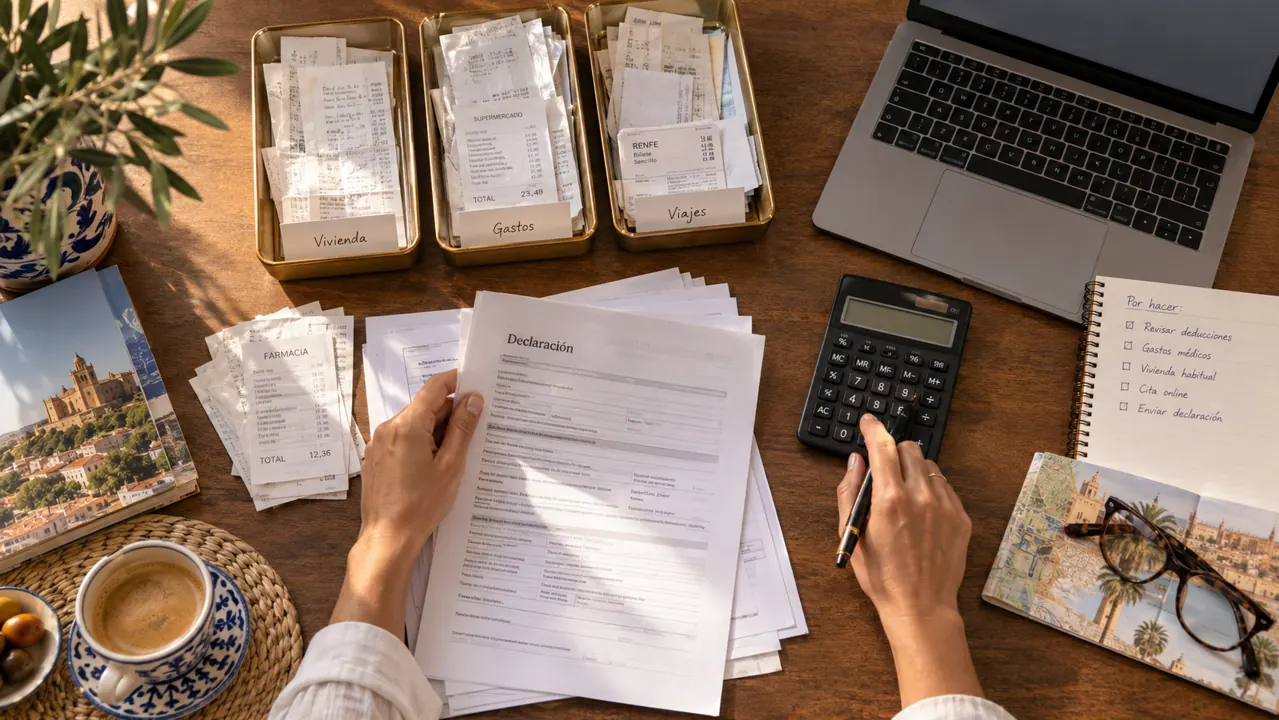
Overseas assets and investments for Spanish tax residents
A framework for reporting, tax, suitability and currency when your wealth remains partly outside Spain.

Keeping savings and investments in another country is common after moving to Spain. The accounts may remain familiar and the investments may still be suitable, but Spanish residence can change how income, gains, ownership and reporting are assessed. The right response is not automatically to sell or transfer everything. It is to build a reliable record, understand the Spanish treatment and then decide whether each arrangement still serves its purpose.
Create one worldwide asset register
List every bank and savings account, brokerage account, fund, shareholding, insurance-based investment, pension, company interest, trust connection, loan and property outside Spain. Record the legal and beneficial owners, country, institution, account type, acquisition date, original cost, current value, currency, income, disposals and tax withheld. Include dormant accounts and jointly owned assets rather than assuming they are irrelevant.
Keep supporting statements and transaction records by calendar year. For investments, preserve purchase prices, reinvested distributions, corporate actions and fees. For overseas property, retain purchase documents, improvement invoices, ownership history, rental records and sale costs. A current value alone is rarely enough to calculate a later gain correctly.
Separate tax from information reporting
A Spanish income-tax return and a foreign-asset information return are separate obligations. Spain's Modelo 720 covers specified categories of assets and rights outside Spain. Whether a filing or later repeat filing is required depends on the current rules, ownership, values and previous declarations. Use the Spanish Tax Agency's instructions for the relevant year and obtain advice where ownership is shared, indirect or connected with a company, trust or policy.
Reporting an asset does not necessarily mean extra tax is due, and paying tax on income does not necessarily satisfy an information-reporting duty. Keep a record of the values, exchange rates and ownership assumptions used so that future filings can be compared consistently.
Check the Spanish treatment of foreign wrappers
Tax advantages normally come from the law of the country that created them. A tax-free savings account, investment bond, retirement account or insurance wrapper abroad may not receive the same treatment in Spain. Spain may look through the label to the underlying income, gains, transactions or legal structure.
Ask a Spanish tax specialist how distributions, internal transactions, withdrawals and disposals are classified before changing the account. If you are a citizen or long-term resident of another country that retains filing rights—such as the United States—coordinate both systems. Do not let one adviser assume that the other country has no continuing interest.
Review investments as one household portfolio
Look beyond the performance of each account. Combine investments with Spanish property, pensions, business interests, borrowing and future spending. Check concentration by company, market and currency; the amount held in cash; expected withdrawals; and whether the household could withstand a sustained fall without selling at a bad time.
An investment denominated in euros does not automatically remove currency risk, and an investment quoted in another currency is not necessarily exposed only to that currency. Focus on the underlying assets and on the currency of future spending. Keep enough accessible money for near-term Spanish expenses without turning the whole long-term portfolio into cash.
Compare the cost of keeping, moving or selling
Before surrendering or transferring an investment, calculate embedded gains, exit penalties, dealing costs, advice fees, platform charges, currency conversion, lost guarantees and any tax triggered in Spain or elsewhere. Compare like with like: the existing arrangement, a modified version of it and the recommended alternative.
Ask for all costs in cash and percentage terms over several years. A recommendation should explain why the change improves suitability after tax and costs, what protections apply, who holds the assets and how the arrangement works if you later leave Spain. Convenience or a familiar expatriate label is not enough.
Verify the firm and service
Investment advice, portfolio management, tax preparation and legal advice are different services. Check the exact legal entity and specific permission in the relevant official register. The CNMV provides information on authorised investment-service bodies in Spain. Where advice or a product is provided from another jurisdiction, check that regulator as well and ask how the service may legally be offered to a resident of Spain.
Confirm fees, commissions, referral payments, custody, product restrictions, complaint arrangements and compensation protections in writing. Be cautious with unsolicited approaches, pressure to transfer quickly, guaranteed returns, unclear ownership structures or requests to pay an unrelated account.
Prepare for a coordinated review
Give the adviser a concise household summary, residence history, recent tax returns, the worldwide asset register, transaction records, pension information, liabilities, expected spending and likely future moves. State which decisions are pending and their deadlines.
The useful output is a written action plan: what must be reported, what should remain unchanged, what needs specialist analysis, the tax and cost of any proposed transaction, and who owns each action. Review it annually and before a property sale, major withdrawal, investment surrender, gift, inheritance or change of country.
Common questions
- Do I need to move overseas investments to Spain?
- No. First compare Spanish tax treatment, reporting, regulation, charges, investment suitability, currency, guarantees and future mobility. Moving can solve one problem while creating another.
- Is Modelo 720 the same as paying Spanish tax?
- No. It is a separate information return for specified foreign assets and rights. Income and gains may also need to appear on the relevant Spanish tax return.
- Does a tax-free account abroad stay tax-free in Spain?
- Do not assume so. The foreign country's label does not determine Spanish treatment. Ask how Spain treats the account, its underlying investments and transactions.
- What records are most important?
- Keep ownership details, acquisition costs, annual statements, income, disposals, fees, foreign tax, exchange-rate calculations and copies of previous Spanish and overseas filings.
Sources
- Individual resident in Spain — Spanish Tax Agency
- Spanish Tax Agency — Agencia Tributaria
- Spain: tax treaties — HM Revenue & Customs
- Modelo 720: information return for assets and rights abroad — Spanish Tax Agency
- Who are the authorised bodies? — CNMV
- FCA Firm Checker — Financial Conduct Authority
- U.S. citizens and resident aliens abroad — Internal Revenue Service
- State Pension if you retire abroad — UK Government
- Transferring to an overseas pension scheme — HM Revenue & Customs
- Considering a defined benefit pension transfer — Financial Conduct Authority
- Living in Spain — UK Foreign, Commonwealth & Development Office
- Planning your cross-border inheritance — Your Europe
This guide provides general information for planning purposes. It does not constitute legal, tax, financial, immigration or medical advice. Always confirm decisions with a qualified specialist authorised to advise for your circumstances.