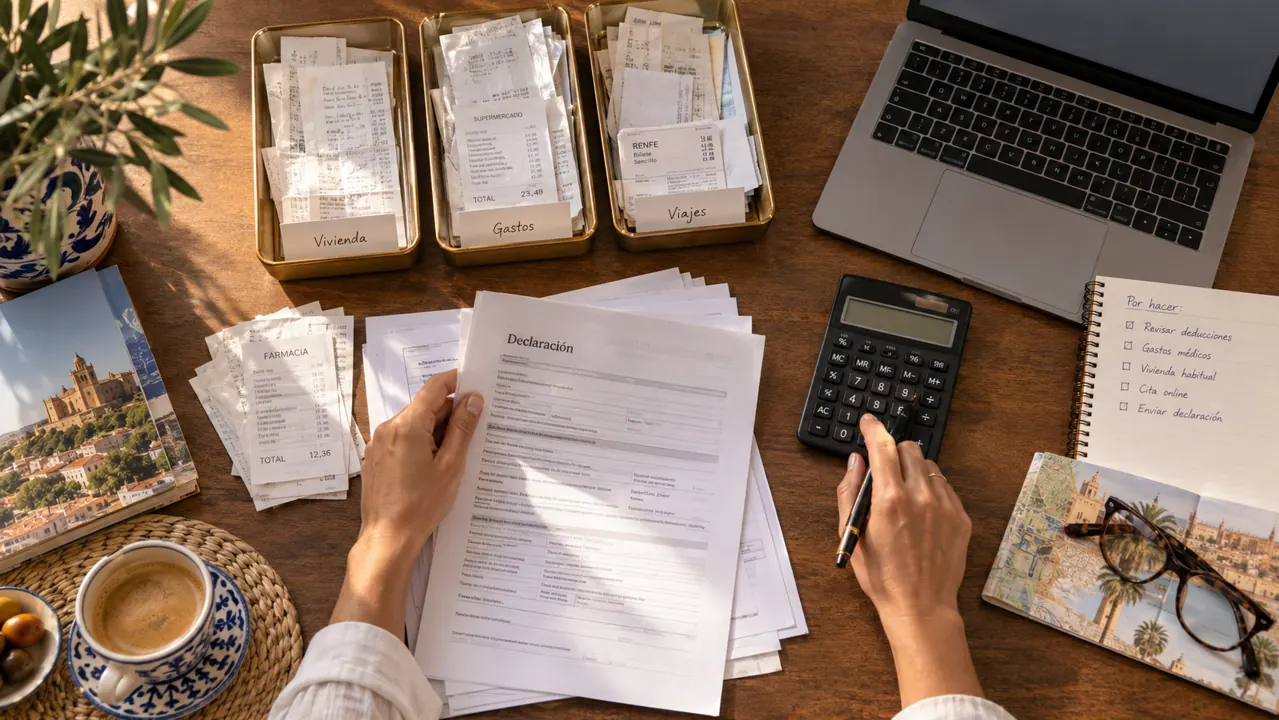
Spanish wealth tax planning for expats
How to organise worldwide assets, valuations, liabilities and regional connections before obtaining personalised Spanish wealth-tax advice.

Wealth-tax planning in Spain begins with accurate residence, ownership and valuation information—not with moving assets into a product. Rules, allowances and regional treatment can change, and separate state-level measures may also need to be considered. Anyone with substantial worldwide assets should obtain current advice for the relevant calendar year and autonomous community before taking an irreversible step.
This guide focuses on the records and questions that make that advice useful. It does not provide a personal calculation or recommend an ownership structure.
Confirm residence and regional connection
Establish whether Spain treats you as tax resident for the calendar year and which autonomous community's rules are relevant. Keep travel records, home information, family connections and evidence of economic interests. If another country also treats you as resident, obtain a treaty analysis rather than assuming the conflict resolves itself.
Residence can affect whether worldwide assets or only specified Spanish assets are considered. Regional rules may influence the result for residents, so an online estimate that ignores location can be misleading. Ask the adviser to state the residence and regional assumptions at the top of the calculation.
Build a defensible worldwide balance sheet
List bank deposits, securities, funds, pensions, insurance policies, private companies, partnerships, trusts, property, vehicles, art, valuables, loans receivable and other material rights. Record legal and beneficial ownership, country, currency, acquisition details and the valuation evidence available at the relevant date. Include jointly owned assets with documented ownership percentages.
List liabilities separately with the borrower, lender, purpose, secured asset, outstanding balance and evidence. Do not assume every debt is deductible or that every foreign pension, policy, company or trust is valued like a simple bank account. Flag complex items for specialist review.
Use the correct valuation basis
Different asset classes can use different statutory valuation methods. Market value, acquisition price, cadastral information, surrender value, balance-sheet value and other measures may be relevant depending on the asset and rules. Ask which basis applies and preserve the source document.
For foreign assets, keep the original currency value and the euro conversion method. Private businesses, unlisted shares, trusts, life policies and jointly held property often need more analysis than listed investments. Avoid creating a precise-looking spreadsheet from unsupported estimates.
Coordinate information reporting and income tax
Wealth-related filings do not replace income-tax or foreign-asset information reporting. Reconcile the balance sheet with income, gains and Modelo 720 records where applicable. An account omitted from one schedule or valued inconsistently can create questions even if the overall tax calculation appears reasonable.
Give all advisers the same ownership and valuation facts. Where a foreign entity or trust is involved, document who controls it, who benefits and which professional is responsible for classification.
Review ownership before changing it
Do not transfer assets to a spouse, child, company, trust or insurance arrangement solely on the basis of a headline wealth-tax saving. A change can create gift tax, capital gains, legal loss of control, creditor exposure, succession consequences, fees or tax in another country.
Compare doing nothing with any proposed change. The written comparison should show immediate and ongoing tax, establishment and administration costs, investment restrictions, access to money, governance, reporting and what happens after death, divorce, incapacity or a later move.
Model cash flow as well as tax
A household can have substantial wealth but limited liquid income. Estimate the cash required for Spanish tax, property costs, debt, insurance and normal living expenses under several market and currency scenarios. Avoid relying on a forced asset sale near a filing deadline.
Consider concentration risk. A large Spanish property, a private business and investments in the same market may expose the household to one economic outcome. Tax planning should not leave the portfolio less suitable or the family short of accessible funds.
Check advice and product incentives
Complex products are sometimes marketed to expatriates as tax solutions. Verify the adviser and provider, the exact regulatory permissions, custody, costs, commissions, liquidity, investment risk and Spanish tax analysis. Ask whether the adviser is paid more if you transfer or invest and whether a Spanish tax professional has reviewed the proposed treatment in writing.
A disclaimer that tax depends on circumstances is not a substitute for analysing your circumstances. Be cautious with urgency, guaranteed outcomes, secrecy or claims that reporting no longer matters.
Set an annual review process
Update the balance sheet before year end and again at the relevant valuation date. Record purchases, sales, gifts, inheritances, debt changes, residence changes and movements between regions. Keep the final calculation, return, valuation evidence and advice together.
Review before a property transaction, business sale, large gift, investment surrender, pension decision, trust distribution or move into or out of Spain. The purpose is not simply to minimise one year's bill; it is to keep tax, reporting, investment, estate and liquidity decisions aligned over time.
Common questions
- Does Spanish wealth tax only cover assets in Spain?
- Residence and the applicable rules matter. Spanish residents may need advice on worldwide assets, while non-residents can have a different scope. Confirm the position for the relevant year.
- Are pensions and insurance policies always exempt?
- Do not assume so. The legal form, rights, valuation and applicable rules must be reviewed for each arrangement, particularly where it was established abroad.
- Should I give assets to family to reduce wealth tax?
- Not without advice. A transfer can trigger gift or capital-gains tax, change control and protection, and create consequences in Spain and other countries.
- What should I prepare for a wealth-tax review?
- Prepare residence and regional evidence, a worldwide asset-and-debt schedule, ownership records, valuation documents, previous filings and details of pending transactions or moves.
Sources
- Individual resident in Spain — Spanish Tax Agency
- Spanish Tax Agency — Agencia Tributaria
- Spain: tax treaties — HM Revenue & Customs
- Modelo 720: information return for assets and rights abroad — Spanish Tax Agency
- Who are the authorised bodies? — CNMV
- FCA Firm Checker — Financial Conduct Authority
- U.S. citizens and resident aliens abroad — Internal Revenue Service
- State Pension if you retire abroad — UK Government
- Transferring to an overseas pension scheme — HM Revenue & Customs
- Considering a defined benefit pension transfer — Financial Conduct Authority
- Living in Spain — UK Foreign, Commonwealth & Development Office
- Planning your cross-border inheritance — Your Europe
This guide provides general information for planning purposes. It does not constitute legal, tax, financial, immigration or medical advice. Always confirm decisions with a qualified specialist authorised to advise for your circumstances.